Charged for a scratch you didn't make? What to do next
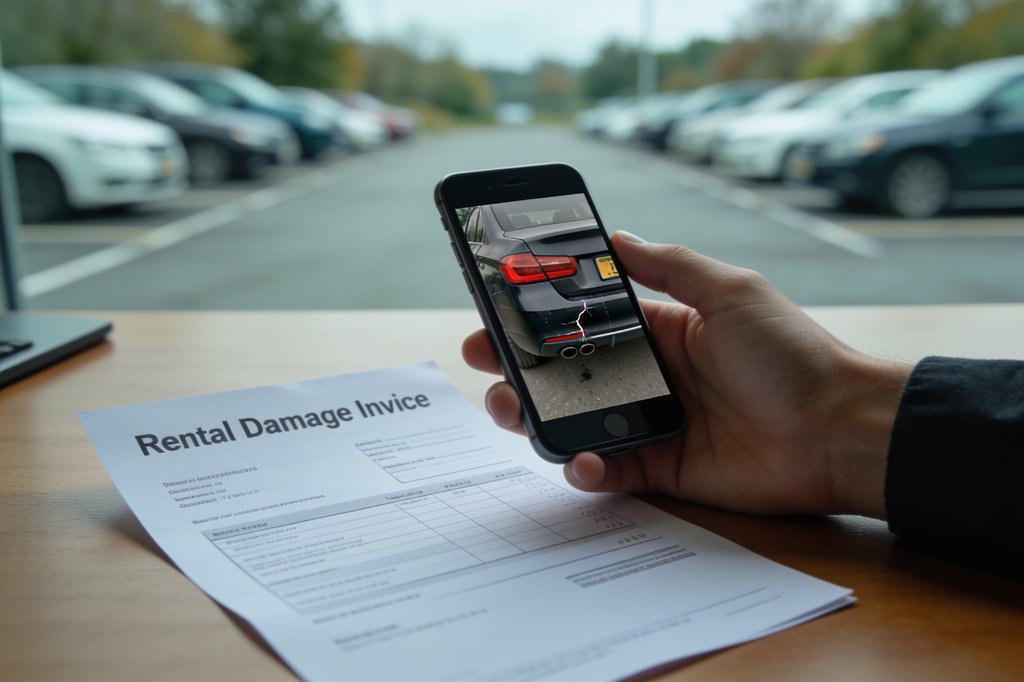
- Ask the rental company to justify the damage, the cost and the timing in writing before you pay or argue.
- Your best proof is what you recorded at pickup and return, plus the dates and paperwork around the charge.
- Escalate in order (the company, your card issuer, a consumer centre or dispute service, then a court) and watch the deadlines.
Before you pay or reply
Start by reading exactly what the rental company sent. Note the amount, the date, which part of the car it points to, and whether the money has already been taken from your card or your deposit, or whether it is only a claim for now.
Do not ignore it, and do not pay in a hurry. Some deadlines start on the day the charge appears on your statement, so write that date down today. In the US, for example, the CFPB says a written billing error notice must reach your card company within 60 calendar days after the charge appeared.
Also check what may already cover you: an excess waiver you bought, your own car insurance, or the rental cover that comes with some cards. Que Choisir suggests rereading these policies, because they may ask you to supply the condition checks when you claim.
Ask for the evidence in writing
Send an email or a letter rather than phoning, so there is a record. Spain's consumer ministry says a company that wants to charge for damage must identify and justify the damage, the amount and the basis for the charge. The European Consumer Centres network advises asking for an explanation and evidence, such as a repair certificate or invoice.
In 2017 the European Commission said Avis, Europcar, Enterprise, Hertz and Sixt had changed their practices. Customers get reasons and evidence of damage before payment is taken, and a chance to challenge it. That is a commitment by five companies in the EU, so do not assume every company or country works the same way. It is still a fair standard to ask for.
If all they send is an estimate they prepared themselves, Que Choisir says charging on that basis can be abusive in France, and you can ask for an expert assessment in which both sides take part. Ask for:
- Dated photos of the damage they are charging for
- The condition check from your pickup and the one from your return
- Proof that the damage was not already there and that it happened during your rental
- The repair invoice, not only an estimate
- A copy of the rental agreement
- Whether the car was rented to someone else after you
Gather your own proof
Build one folder, digital is fine, and put everything from the rental in date order.
If you filmed the car at pickup with RentalProof, the report emailed to you and to the rental company carries a server-verified time and GPS location and is sealed in Bitcoin. It shows when and where the files were made.
Return photos matter as much as pickup photos. The European Consumer Centres network notes that cars returned outside office hours are usually inspected the next day, and charges can come later. Que Choisir says that if you left the keys in a drop box, you will need to show the car was in good condition when you left it, for example with dated photos.
- Pickup photos and video, and any condition check you signed
- Return photos and video, and any return report
- The rental agreement, payment receipts and the fuel receipt
- A screenshot of the charge on your statement
- All emails, plus the names and times of any calls
- Witnesses, or the previous renter's return report if the car was dirty and the scratch was hard to see (Que Choisir)
- Your phone's location history, if the claim is about where you drove (CoverTrip suggests saving it before it expires)
Write a short, factual dispute
State facts, not accusations. Give the agreement number, the dates and the amount, and say plainly that you dispute the charge because the damage did not happen during your rental.
Send it to the company's customer service or head office, not only to the local branch. In France, Que Choisir suggests registered mail with acknowledgement of receipt or the message form in your customer account. CoverTrip suggests giving a reasonable reply date, usually 14 days.
- Agreement number, dates and amount
- The charge you dispute and why
- What you attach
- The documents you want from them
- A date for their reply
Escalate in order and watch the deadlines
If the company does not answer, refuses without evidence or keeps the money, move up one step at a time. What is available depends on where you rented and how you paid. Open the card dispute early, alongside your letter to the company, rather than waiting for a reply.
We did not find one rule for Latin America. Check your rental contract and your country's consumer protection agency, and use the same evidence-first approach.
- Card issuer, US: the CFPB says to call right away and send a written billing error notice within 60 calendar days. You can dispute a charge you already paid, but you probably will not get the money back until the card company decides you were right.
- Card issuer, UK: GOV.UK says that if you paid by credit card and something went wrong, especially a misrepresentation or breach of contract, you can claim under section 75 of the Consumer Credit Act.
- Card issuer, EU: the European Consumer Centres network says to explain your complaint and ask whether a chargeback is possible. In France, Que Choisir says your bank can refund a payment that exceeds what you authorised or could reasonably expect.
- European Consumer Centre: free help to mediate if the company ignores or rejects your complaint. UK consumers can use the UK European Consumer Centre for purchases in another EU country.
- Dispute services: the European Car Rental Conciliation Service, the BVRLA service for UK rentals, ABTA for some booking agents, or a national dispute body. The decision binds a participating company but does not limit your right to go to court.
- Spain: you can go to consumer bodies or the Junta Arbitral del Transporte. For disputes up to 15,000 euros, the company is presumed to accept it unless a party expressly excluded it before the rental. GOV.UK also says you can ask for the official complaint form, the Hoja de Reclamacion.
- Courts: the European Small Claims Procedure covers cross-border claims up to 5,000 euros. In the US, CoverTrip mentions your state consumer protection office and small claims court.
- US collection notices: CoverTrip advises disputing in writing within 30 days and asking them to validate the debt.
If you have no pickup record, or you already signed
Without a record of the car's starting condition, the position is weaker but not hopeless. Spain's consumer ministry says the Civil Code presumes you received the car in good condition, and you answer for damage during the rental unless you show it happened without your fault. Que Choisir describes the same presumption in France.
You can still use other evidence: photos taken at any point, messages, witnesses. Que Choisir also says that billing on an inspection you did not attend, or on the company's estimate alone, can be abusive, and that you should be able to ask for an expert assessment.
If you disagree at the return desk, Que Choisir advises not signing the return report. Signing counts as acknowledging the damage, though you can still try to prove it did not happen during the rental. Rules differ by country and by company, and no outcome can be promised. This is general information, not legal advice.
Sources
- 1Location de voiture - Que faire quand ça se passe malQue Choisir · quechoisir.org
- 2Alquilé un coche y, al devolverlo, me dicen que he ocasionado unos daños que no existían antes. ¿Puedo reclamar?Ministerio de Derechos Sociales, Consumo y Agenda 2030 (España) · dsca.gob.es
- 3¿Problemas con el coche de alquiler? ¡Reclama!OCU · ocu.org
- 4Renting a car: what to look out forGOV.UK (Competition and Markets Authority) · gov.uk
- 5Car Rental RightsEuropean Consumer Centres Network (ECC-Net) · eccnet.eu
- 6Car rental companies improve treatment of consumers, thanks to EU-wide enforcementEuropean Commission · europa.eu
- 7How do I dispute a charge on my credit card bill?Consumer Financial Protection Bureau · consumerfinance.gov
- 8How to fight a rental car damage scamCoverTrip · covertrip.com
Your feedback on RPA
Private, only the RPA team reads it.