Charged for damage after returning a rental car? What to do
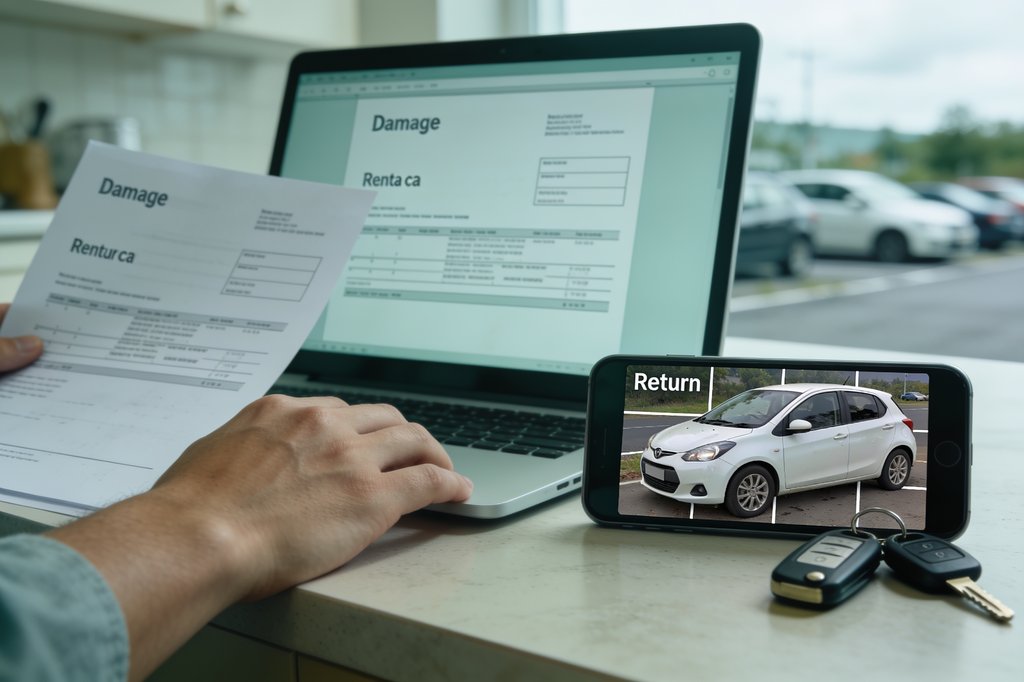
- Do not ignore the charge and do not pay in a hurry: ask the rental company in writing to prove the damage and justify the amount.
- Your pickup and return paperwork and dated photos decide most of these disputes, and who has to prove what depends on the country.
- If the company refuses or stays silent, you can go to your card issuer, a mediation or conciliation service, a consumer centre, or court.
Why a charge can arrive after you have left
Damage charges are the single largest cause of car rental complaints, according to the UK Competition and Markets Authority. The European Consumer Centres Network says the same about the EU: disputes over damage surcharges after the car is back are the most common problem in the sector.
It often happens after an out-of-hours drop-off. The ECC-Net notes that cars returned outside opening hours are usually inspected the next day, and the renter can be charged for damage at a later stage. A staff check you were not present for is the weakest part of the process, and it is the part you can challenge.
Start with the paperwork, not with a payment
Read the notice or email carefully. Note what damage is claimed, where on the car, the amount, and whether the money was taken from your deposit or your card or is still only requested.
Then collect everything you have from the rental: the contract, the condition form from pickup, the return form or receipt, your photos and videos, and the fuel receipt if fuel is part of the claim.
Also check your cover. If you bought an excess waiver, or your own car policy or bank card includes rental cover, the damage may be covered. Que Choisir advises reading these contracts, because some ask you to produce the condition reports.
Ask for the evidence in writing
Both the ECC-Net and the UK government guidance give the same first step: contact the rental company in writing and ask for evidence of the damage, in the form of a repair invoice or certificate.
Que Choisir adds that billing you from a quote the company produced under its own control can be abusive, and that you can ask for an independent assessment of the damage. In the EU, Avis, Europcar, Enterprise, Hertz and Sixt agreed with the European Commission and consumer authorities to a clear inspection procedure, to prove and justify damage before charging, and to let consumers contest it first.
- The damage report, with dated photos of the damage
- The repair invoice, or at least a detailed quote
- How the amount was calculated, including any admin fee
- A copy of the return form or inspection record
Who has to prove what
The rule depends on the country and on the law named in your contract, so check both. Two official sources show the logic.
In France, Que Choisir explains that without a condition check the car is considered to have been in good condition when you took it, so you are presumed responsible unless you prove otherwise. If a return condition check was done with you and lists no damage, the rental company has to show the damage happened during your rental, which can be hard for it.
In Spain, the consumer ministry gives a similar answer. If the starting condition was not recorded, the Civil Code presumes you received the car in good condition, and the renter answers for deterioration during the rental unless they prove it was not their fault. The company must still identify and justify the damage, the amount and the basis of the charge.
If you disagreed with the return form, Que Choisir advises not signing it. Signing it means you acknowledge the damage.
Write a short, factual complaint
Keep the message calm and specific. Give your contract number, the pickup and return dates and places, the amount you dispute, and what you want: cancel the charge, refund it, or send the evidence.
Attach copies of your proof, never originals. Send it in a way that leaves a trace. In France, La Poste and Que Choisir suggest the customer service by email from your account or a registered letter with acknowledgement of receipt. La Poste suggests giving a reasonable deadline, generally 15 days.
State the facts and do not accuse. Do not write that you accept any part of the damage unless you do.
- Say when and where you returned the car and who checked it
- Say that no damage was recorded at return, if that is the case
- Ask for the invoice, photos and calculation within the deadline
- Keep a copy of everything you send
If the company refuses or does not answer
Escalate step by step. None of these routes guarantees an outcome, but each one adds pressure and each one needs your file to be in order.
- Your card issuer. The ECC-Net says to explain the complaint to your card provider and check whether a chargeback is possible. In the UK the government guidance points to section 75 of the Consumer Credit Act for credit card payments. In the US the FTC says a billing dispute letter must reach the issuer within 60 days after the first bill with the error. Time limits vary by card and issuer, so act quickly.
- Mediation or conciliation. In France the rental company must give you its consumer mediator, and Que Choisir says to use it if your complaint fails. In the UK there is the BVRLA Conciliation Service, and for cross-border rentals in the EU the European Car Rental Conciliation Service. In Spain you can go to consumer bodies or to the Junta Arbitral del Transporte, which is presumed to apply to disputes up to 15,000 euros unless a party excluded it before the rental.
- A consumer centre. For a rental in another EU country, your national European Consumer Centre can examine your case and mediate for free. In the UK, Citizens Advice is the starting point for rentals in the UK.
- Court. For cross-border claims in the EU, the European Small Claims Procedure covers claims up to 5,000 euros through your local court.
Key box and after-hours returns
If you left the car in the agency car park and put the keys in a drop box, you can still contest a charge. Que Choisir says you need to show the car was in good condition when you left it, for example with dated photos.
Some contracts make you responsible until the agency opens. In a case brought by Que Choisir, a French court cancelled 23 clauses in Sixt's conditions, including this one, and said that a customer who has left the car and keys in the box no longer has legal custody of it. Sixt appealed and the decision was not final when Que Choisir wrote about it in 2021, so check the current position before relying on it.
Sources
- 1Location de voiture - Que faire quand ça se passe malQue Choisir · quechoisir.org
- 2Alquilé un coche y, al devolverlo, me dicen que he ocasionado unos daños que no existían antes. ¿Puedo reclamar?Ministerio de Derechos Sociales, Consumo y Agenda 2030 (Spain) · dsca.gob.es
- 3Litige avec une agence de location de voiture : comment contester les frais ?La Poste · laposte.fr
- 4Car Rental RightsEuropean Consumer Centres Network (ECC-Net) · eccnet.eu
- 5Renting a car: what to look out forCompetition and Markets Authority, GOV.UK · gov.uk
- 6Using Credit Cards and Disputing ChargesFederal Trade Commission (US) · consumer.ftc.gov
Your feedback on RPA
Private, only the RPA team reads it.